
Liberty Does Not Survive on Theory Alone, It Must Be Defended in the Real World
There comes a point when a movement has to confront a simple, uncomfortable reality:
If your ideas are right, but you can’t translate them into power, what exactly are you preserving?
Libertarians have spent decades refining a philosophy of individual liberty, free markets, and limited government. On paper, it is coherent, moral, and compelling. In practice, it has struggled to take root in a country that feels increasingly fractured, anxious, and politically volatile.
That disconnect is no longer something we can ignore.
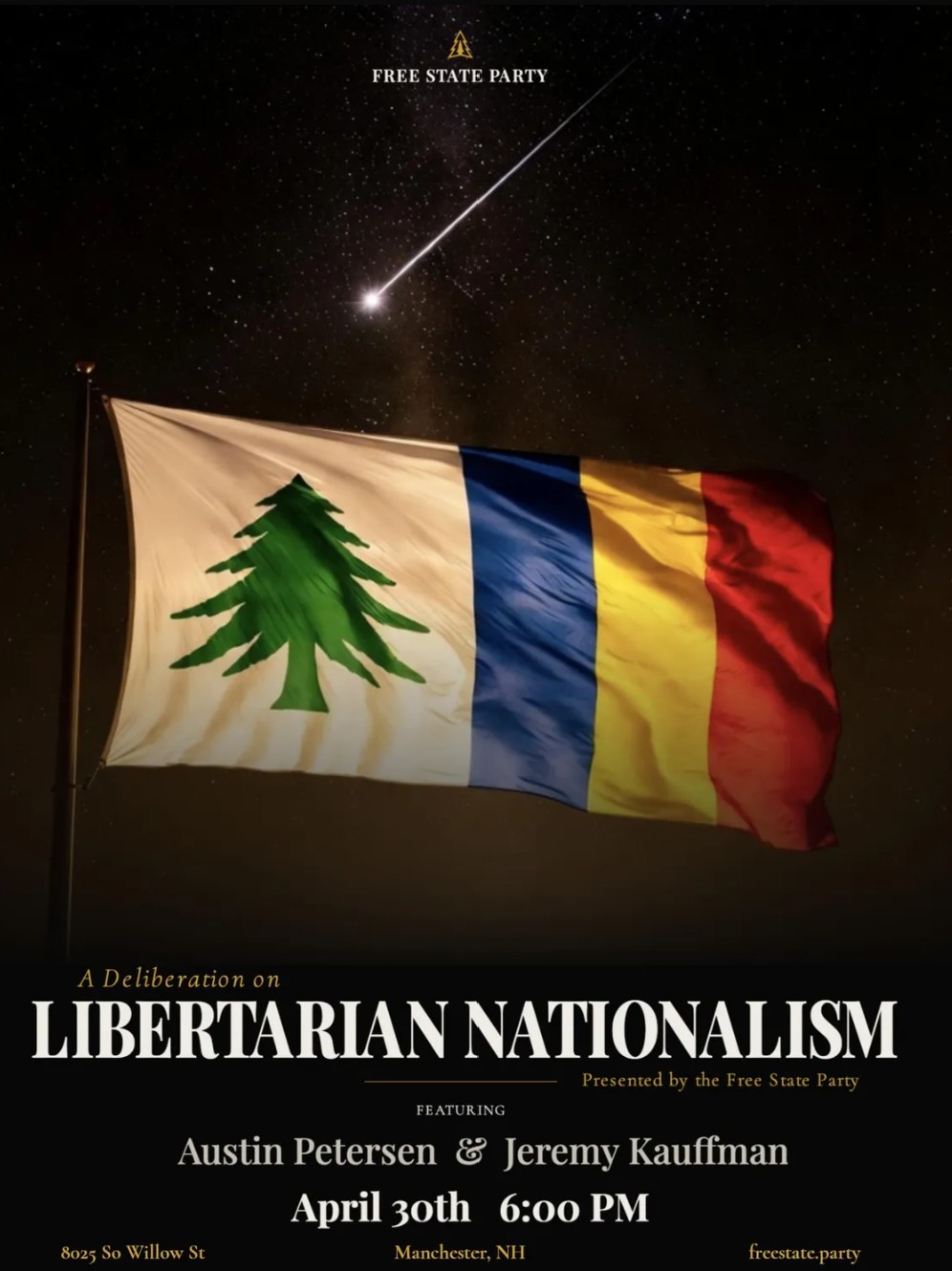
On April 30th at 6:00 PM in Manchester, New Hampshire, I’ll be joining Jeremy Kauffman for a live event hosted by the Free State Party:
A Deliberation on Libertarian Nationalism
This conversation is about a tension many in the liberty movement have avoided for too long.
For years, libertarians have treated nationalism as something to reject outright. The concern is understandable. Nationalism, when untethered from principle, can drift into collectivism, centralization, and the very kind of state power we oppose.
But dismissing it entirely has created its own blind spot.
Because nations exist. Borders exist. Cultures exist. And political power is exercised within those realities whether we like it or not.
Meanwhile, the political landscape around us has shifted.
On one side, you have a rising nationalist energy that is often disconnected from any serious commitment to liberty. On the other, a globalist framework that seems increasingly indifferent, if not hostile, to national cohesion, shared identity, or constitutional limits.
Libertarians have largely stood off to the side, critiquing both, but offering little that feels grounded in the actual conditions people are living in.
That’s beginning to change.
What some of us are calling “libertarian nationalism” is an attempt to wrestle with that reality head-on. Not as a slogan, but as a question:
What does it look like to preserve liberty within a nation that must also preserve itself?
That question forces a few others into the open:
- Can a free society endure if the culture no longer values freedom?
- Can you maintain limited government without some shared sense of identity or purpose?
- And if libertarians refuse to engage with questions of nationhood, who fills that vacuum?
These are not academic concerns anymore. They are showing up in elections, in policy fights, and in the way Americans increasingly view each other.
New Hampshire is one of the few places where these ideas can actually be tested in real time.
The Free State movement has brought thousands of liberty-minded people into one state with the explicit goal of turning principle into practice. That creates a rare opportunity, but also a responsibility. It forces the movement to grapple with questions that theory alone can avoid.
That’s why this event matters.
Jeremy and I are coming to have an honest, open, and sometimes uncomfortable conversation about where the liberty movement goes from here. There will be agreement in some places, disagreement in others, and hopefully a clearer understanding of what’s at stake.
More than anything, this is an invitation.
If you care about liberty, this is your conversation too. Not something to watch from a distance, but something to participate in.
Paine wrote that “these are the times that try men’s souls.” He wasn’t writing about comfort. He was writing about decision.
We are in a moment where the direction of the movement is not settled. It is being shaped right now by the people willing to show up and engage.
If that sounds like you, join us.
April 30th, 6:00 PM
8025 S Willow St, Manchester, NH